
How to Improve B2B SaaS Pipeline Quality in 2026
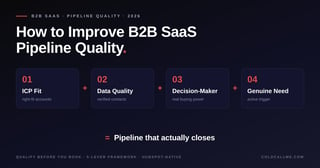
You improve B2B SaaS pipeline quality by qualifying before you book, not after — confirming ICP fit, verified data, decision-maker access, and a genuine need for every opportunity that enters the funnel. Volume metrics like dials and booked meetings feel productive, but they hide the real problem: a pipeline full of curiosity calls, no-shows, and stalled deals. This guide explains what pipeline quality actually means, how to measure it, why it degrades, and the five levers that fix it.
What “pipeline quality” actually means
Pipeline quality is the share of your pipeline that has a real chance of closing. A high-quality pipeline is smaller and more honest than a vanity pipeline — it’s built from opportunities where the buyer fits your ICP, has authority or clear access to it, and has a genuine reason to act now.
The trap in B2B SaaS is mistaking activity for pipeline. A rep can book ten meetings this week and add nothing to real pipeline if those meetings are with the wrong people or the wrong-fit accounts. Quality is measured at the point of qualification, not at the point of booking.
How to measure pipeline quality
Four metrics tell you the truth faster than total pipeline value:
- Meeting-to-opportunity rate — what share of booked meetings become real opportunities. Low rates mean you’re booking unqualified meetings.
- Show rate — no-shows are the clearest signal of weak qualification or wrong-fit targeting.
- Stage conversion — where deals stall reveals whether you qualified for need and authority up front.
- Win rate by source — if a channel’s win rate is far below average, it’s producing low-quality pipeline regardless of volume.
If your booked-meeting count is healthy but these four are weak, you have a quality problem, not a volume problem. (We documented what actually moves these numbers in our field research on what books meetings.)
Why pipeline quality degrades
Quality slips for predictable reasons: targeting drifts away from a tight ICP, contact data goes stale, reps optimize for booked-meeting quotas instead of qualified ones, and messaging gets generic. Most outbound programs that fail do so in the first 90 days for exactly these reasons — we break that down in why outbound programs fail early.
The five levers that improve pipeline quality
Cold Call Me runs every program on five measurable levers. They map directly to pipeline quality:
- Data Quality — verified, current contacts. Bad data is the fastest way to waste a quarter; it’s why we treat it as Lever 1.
- Lead Quality — tight ICP discipline. Start from a well-built ICP, not a broad list.
- Agent Activity — the right volume of the right touches, sustained long enough to develop a SaaS cycle.
- Messaging — relevant, specific outreach that earns a real conversation instead of a courtesy meeting.
- Methodology Adherence — consistent qualification on every opportunity, so quality doesn’t depend on which rep dialed.
The full framework is here: the 5-Lever Framework.
How to fix it in practice
Start by tightening your ICP and purging stale data — those two moves alone lift quality fast. Then change what you reward: measure reps on qualified opportunities, not booked meetings. Require a simple qualification standard (right person, real need, ICP fit) before any meeting reaches an AE — the plays in AE-friendly meeting generation protect AE time exactly this way. Finally, make pipeline visible by stage in your CRM so quality problems surface early instead of at quarter-end.
If you’re weighing whether to build this discipline in-house or bring in a partner, our Outsourced SDR vs In-House comparison covers the trade-offs.
Frequently asked questions
What is B2B SaaS pipeline quality? The share of your pipeline that can realistically close — built from opportunities with ICP fit, decision-maker access, and a genuine need, rather than booked-meeting volume.
How do I measure pipeline quality? Track meeting-to-opportunity rate, show rate, stage conversion, and win rate by source. Weakness there signals a quality problem even when total pipeline looks healthy.
Why is my pipeline full but my win rate low? Almost always weak qualification — you’re adding meetings, not opportunities. Tighten ICP, verify data, and qualify for need and authority before booking.
Does booking more meetings improve pipeline? Only if they’re qualified. More unqualified meetings lower quality and waste AE time.
How fast can pipeline quality improve? Tightening ICP and cleaning data shows up within weeks; durable improvement comes from consistent qualification on every opportunity.
How does the 5-Lever Framework help? It makes the inputs to quality — data, lead fit, activity, messaging, and consistent methodology — measurable, so you can fix the specific lever that’s dragging quality down.
Want a higher-quality pipeline?
If your SaaS pipeline looks full but doesn’t close, the problem is usually quality, not volume. Talk to us about a program that qualifies before it books — and reports it natively in HubSpot.